Wednesday, November 29, 2023

Charles Stevens, 21st Regiment of Foot, Goes to the Dogs

 Charles Stevens was a cordwainer from the town of Airth in County Stirling, Scotland, a few miles up the River Forth from Edinburgh. He joined the army in 1758 at the age of twenty-five, enlisting in the 21st Regiment of Foot, called the Royal North British Fusiliers and composed largely of men from the Scottish lowlands. His regiment soon traveled to North America, moving around through various colonies from Quebec all the way to West Florida, before finally returning to England in 1773.

It would be a short stay. War broke out in America in 1775, and in early 1776 the 21st was crossing the Atlantic again, one of nine regiments sent to relieve the siege of Quebec City. There, joined by another regiment already in America, they helped to drive invading rebel Americans away from the city and all the way back into New York. The onset of winter prevented an assault on Fort Ticonderoga that year, and the 21st went into quarters in Canada for the winter.

The following year saw the regiment on the ill-fated campaign up Lake Champlain toward Albany, that culminated in surrender at Saratoga. It is not clear whether Stevens was on the campaign or not, but later events suggest that he may have been a servant to Lieutenant George Brody. By June 1781, when many soldiers of the 21st were still languishing in American prisoner of war camps, Charles Stevens was back in Great Britain, on recruiting service with now-Captain Brody. He attained the rank of sergeant.

After serving twenty-five years, Stevens was discharged from the army in late 1783 at the age of fifty. He went before the pension examining board at Chelsea Hospital outside of London in December, and again in January 1784, where he was granted an out-pension. He then settled far north of his home town, in the counties of Moray and Nairn. As an out-pensioner, he went to the nearest excise office twice a year to collect his pension, roughly five-eighths of his sergeant's pay. But he didn't show up to collect in the second half of 1786, nor at all in 1787.

In June 1788, Stevens went before a justice of the peace in Cupar, County Fife, to explain his absence and collect the pension funds due to him. In July 1786, he had gone to Ireland with his old commanding officer, Captain Brody, who presumably was there recruiting. Brody, now back in Edinburgh, wrote a letter of support. He explained that Stevens' long absence was "intirely given to the poor Old Soldiers attachment to me, as His Captain formerly"; Stevens had "been in Ireland with me, for two years taking care of my Dogs." Captain Brody was, in his words, "bound by Honour to see the Old Soldier paid for this strong attachment."

This installment is based on the muster rolls of the 21st Regiment of Foot, WO 12/3778/2, the pension admission book, WO 116/8, and the letters by Captain Brody and the justice of the peace, WO 121/138/624, all in the British National Archives.

Learn more about British soldiers in America.

Sunday, July 9, 2023

William Nowland, 46th Regiment of Foot, serves from 18 to 62

 When he set foot on a sandy barrier island near Charlestown, South Carolina in the first half of 1776, William Nowland was already a seasoned soldier. The Enniscorthy, County Wexford native had joined the 46th Regiment of Foot on 22 April 1769 at the age of eighteen; now, having completed seven years of soldiering, he was barely beginning his army career.

The 46th Regiment spent several weeks encamped on the hot, barren Carolina coast as part of an expedition that was supposed to bring the region into British control, but which ended in failure. The seven regiments and the naval fleet that brought them to America then proceeded north to Staten Island, joining in August the large British army gathered there. In preparation for a new campaign, Nowland was transferred into his regiment's light infantry company. This company joined the light infantry companies from the other six regiments from the Charlestown expedition, forming the 3rd Battalion of Light Infantry. This temporary formation operated independently of the companies' parent regiments, instead working with two other light infantry battalions to form the vanguard of the army.

At the end of August, the army, led by the light infantry, successfully seized Long Island. In September they took New York City, and in October proceeded with a campaign to wrest the region surrounding Manhattan from rebel control.

The light infantry figured heavily in the campaigning in Westchester County, New York, but Nowland didn't remain long in that company. At the end of October he was appoint corporal in another company of the 46th Regiment. In his new role he probably took charge of a "squad of inspection," ensuring that about a dozen men were always fit for duty, their clothing and equipment clean, their diets and discipline properly managed. When on guard duty he posted pickets and sentries. In February 1778, when the regiment was in Philadelphia, he called the roll one evening and discovered a soldier missing; following normal procedure, the next morning he checked to see whether the man had taken anything with him. "Upon examining his knapsack yesterday morning," Nowland testified at the soldier's trial for desertion, "he found that all his necessaries, except a pair of shoes & a piece of an old Shirt had been taken out, & he was informed that he had taken away a Shirt of his Comrades."

The British army departed Philadelphia in June 1778, returning to the area around the city of New York. Late that year, the 46th and nine other regiments embarked on an expedition to the West Indies to defend British interests there against the French. They landed in St. Lucia in December, and soon drove away an attacking French army. Some time before the end of 1779, William Nowland was appointed sergeant.

Service in the West Indies meant spending a lot of time on ships, often on warships rather than the transports that usually moved soldiers from one place to another. Several times, British soldiers participated in naval battles. One of these was the Battle of Martinique on 17 April 1780, an inconclusive action that prevented a French fleet from reaching British-held Jamaica. Casualties on both sides were light, but Sergeant William Nowland was wounded in the leg during the fighting while on board the 60-gun ship Medway.

A career soldier, he continued to serve in the 46th Regiment. He stayed in the army until November 1794, when he was discharged due to "old age, being worn out in the service" in addition to having been wounded. His discharge paper noted that he had been wounded in the right leg. He was granted a pension. But he didn't stay away from the army for long.

In December 1795 William Nowland joined an invalid corps, composed of soldiers who were not fit for campaigning but could help defend Great Britain's coast. He stayed in that corps until December 1802, when he joined the 3rd Royal Veteran Battalion, a similar organization. With them he served another six years, taking his discharge in December 1808 after almost forty years as a soldier. His discharge mentioned that he had "an old ulcer," included the note, "the mark of his wound is in his left leg."

But he still had more to give to the army. He took a job in the Barrack Office on the Isle of Jersey. He finally resigned from that post on 3 August 1813 "on account of ill health."

Information for this post comes from the following documents in the British National Archives:

Muster rolls of the 46th Regiment of Foot, WO 12/5796 and WO 12/5797

Discharges of William Nowland, WO 121/21/230 and WO 121/170/179

Acknowledgement of William Nowland's resignation, WO 121/176/105

Court Martial of James Garraty, WO 71/85, p. 281–283

Learn more about British soldiers in America!

Tuesday, April 4, 2023

Donald McPherson, 71st Regiment, gets two stabs and a slice

The surgeon looked over Donald McPherson's right arm. It was a bayonet wound, no doubt. There, on McPherson's left arm, was another. As if the two stab wounds weren't enough, McPherson had a saber cut on his head. This man had done some hard, close-quarters fighting.

Donald McPherson hailed from Boleskine Parish, at the southern end of Loch Ness in Invernes Shire. Born in 1746, he took up the trade of tailoring. But in 1775, after war broke out in America, McPherson was one of over two thousand highlanders who answer the call for recruits in a new regiment, the 71st Regiment of Foot, called Fraser's Highlanders after their commanding officer, raised specifically for the North American conflict. McPherson was new to the army, as were many of his comrades, but the enlistees also included many veterans of the previous was that ended in 1763. The regiment was new, but in the ranks there was much military experience.

The 71st, organized into two battalions of ten companies each, with 100 private soldiers in each company, sailed from Scotland in April of 1776. They made for Boston, not knowing that city had been abandoned by the British army. Some of their transports ran afoul of American privateers; about a quarter of the regiment became prisoners of war before even making landfall. The rest of the regiment, including McPherson, put in to Halifax, Nova Scotia, only to find that the army had recently departed from that place. The highlanders finally caught up with the British army on Staten Island, where they landed at the beginning August 1776.

Just three weeks later the army was on the move. Over 20,000 British and German soldiers crossed from Staten Island to Long Island. Several days later, part of the army made a feint towards American lines in Brooklyn while the rest, including the 71st Regiment, made a long nighttime march east, then north, and finally back to the west, around the flank of the American defenses. The Battle of Long Island, or Battle of Brooklyn, began in the morning of 27 August and ended in a total rout of American forces. 

In some places the defenders put up a determined if futile fight. Individual companies of British grenadiers, light infantry and highlanders fell into close combat as they rapidly overtook surprised and retreating Americans. In some places the fighting was hand to hand. Donald McPherson, in the army for less than a year and in his first battle, suffered three wounds, two from bayonets (or perhaps from the same bayonet) and one from a saber.

Careful comparison of British casualty returns to regimental muster rolls reveals something counterintuitive: most wounded British soldiers survived their wounds. McPherson was among those survivors. In spite of receiving three wounds on the same day, he not only recovered, but rejoined his regiment and served for the remainder of the American War. The 71st Regiment suffered many casualties during their seven years in America, but McPherson was among those who returned to his native Scotland at the end of hostilities.

The 71st Regiment was disbanded at the end of the war, it's soldiers sent home and mustered out in Scotland. When war with France was declared in 1793, he returned to soldiering, spending six years in a regiment called the Strathspey Fencibles, a corps that served only within the boundaries of Scotland. He served for the entire six-year existence of that regiment, which was disbanded in 1799.

His military career was not yet finished. After leaving the Fencibles, he joined the Argyleshire Militia as a substitute - that is, serving instead of another man who was obliged to serve. He was finally discharged from that regiment on 1 May 1802 at the age of forty-six, having spend sixteen of those years as a soldier. An army surgeon noted on his discharge that the scars from his wounds were still evident. He was awarded an army pension.

Learn more about British soldiers in America!

[Information in this post is from the discharge of Donald McPherson from the Argyleshire Militia, WO 121/53/289, in the British National Archives, and from general information about the 71st Regiment of Foot]

Sunday, February 12, 2023

Joseph and Mary Whitaker, 17th Regiment of Foot, make their claims

A few miles southwest of Dublin is a village called Kill, in County Kildare. In 1736, Joseph Whitaker was born there. He grew up to pursue the trade of a whitesmith, crafting metal into products with shiny surface finishes. This was a good trade, but for some reason not enough for the young Irishman; at the age of twenty he enlisted in the army.

His skill and education served him well as a professional soldier. After nine years, he was a sergeant, the highest rank that most common soldiers could expect to achieve, and one in which afforded numerous opportunities for earning extra money over and above the base pay. By 1772 he was in the 17th Regiment of Foot, a regiment that had spent ten years in North America, first participating in the sieges of Louisbourg in 1758, Ticonderoga in 1759, Montreal in 1760, then in the West Indies, and on the American frontier during Pontiac's Rebellion. It is not known whether Whitaker was in the 17th during this time, or served in a different regiment before joining the 17th. Whether he had been to America before or not, in late 1775 he embarked with his regiment for Boston to reinforce the British garrison that was besieged there.

The 17th Regiment of Foot disembarked in Boston in December 1775. Joseph Whitaker served in the regiment's grenadier company. Detached from the regiment and joined with other grenadier companies to form a grenadier battalion, Whitaker's company was in the forefront of many of the war's most fierce and famous battles. He came through it all unscathed. And his time in America brought more good fortune to him.

The British grenadier battalions spent most of the second half of the war quartered in the area of New York City. Probably during that time, he met Mary Williams, a widow who had lived in the city "prior to and during the troubles." She ran a business "in the public line" - probably referring to a public house or tavern - and did well enough to purchase property "in her own right for ever." Her holdings amounted to between four and five hundred pounds, a testament to her enterprise. She married Sergeant Whitaker, who by this time may have accumulated a fair amount of cash from his work for the army. In terms of prosperity, their future looked bright.

No amount of marital optimism, however, could overcome the tide of events for the British military and Loyalist citizens in America. By 1783 the war was lost. The army and a large number of inhabitants were forced to abandon the city of New York. Joseph and Mary Whitaker left their property "to the mercy of the rebels," and sailed with the 17th Regiment to Halifax, Nova Scotia. They didn't stay there long. A reduction in forces afforded Sergeant Whitaker the opportunity to be discharged. 

The couple went to England, where Joseph Whitaker went before the army pension examining board at Chelsea, near London, in February 1784, and was awarded a pension. This would afford a modest but sufficient income for them. Mary Whitaker made a claim to have her losses compensated by the British government, but hers was one of thousands of such claims. Whether she ever received any payment is not known.

Information in this installment come from the muster rolls of the 17th Regiment of Foot (WO 12), the army out-pension admission books (WO 116), and Audit Office records (AO 13), all in The National Archives of Great Britain.

Learn more about British Soldiers in the American Revolution

Saturday, September 10, 2022

John Bartley, 31st Regiment, knows the war is over

The terms of enlistment were very clear to John Bartley: service would be over “at the end of three years, or at the end of said Rebellion, at the option of His Majesty.” These were the terms prescribed by the British War Office for enlistments after December 16, 1775. The British government had committed to using military force to quell a rebellion in thirteen British colonies in North America. This required a significant increase in the size of the army. The established strength of regiments deployed to America was increased by 50 percent, an increase met partly by transferring men from non-deployed regiments and partly by new recruits.

John Bartley was one of those recruits. The five foot nine-and-a-quarter inch tall Scotsman enlisted in the 31st Regiment of Foot in early 1777 at the age of twenty-four. Later that year he was on a transport with other recruits, bound first for Quebec and then going on to the regiment's post at St. Johns on the Richelieu River between Lake Champlain and Montreal.

Bartley served uneventfully enough that no mention of him has been found other than his name on muster rolls throughout the rest of the war. The 31st's grenadier and light infantry companies went on the 1777 campaign towards Albany and were captured at Saratoga that October, remaining in captivity for the rest of the war. In 1781 the regiment selected suitable men from the eight remaining companies to create new grenadier and light infantry companies; Bartley was among those chosen to be a grenadier.

Early in 1783 a peace treaty was signed. The war that had been winding down for months was now officially over. There were now innumerable administrative and logistic tasks involved in reducing the army to a peacetime footing. The 31st Regiment was in Quebec, so it didn't need to go anywhere, but around half of the soldiers were eligible for discharge because of reduced manpower needs. Officers awaited orders for how to proceed with this, but John Bartley decided for himself that his military career was over. In April, probably soon after news of the finalized peace treaty reached Quebec, he refused to do any more duty. As far as he was concerned, he was done.

His officers, not surprisingly, had a different point of view. Bartley was tried by court martial on May 1, found guilty, and sentenced to be punished with 500 lashes. The commander in chief in Quebec reviewed the case and chose to forgive Bartley "in consideration of the Prisoners good character, his confession of having been misled and acted through ignorance." In general orders the commander proclaimed that he hoped Bartley's case would "be a warning and prevent any other soldier from falling into the like error."

Those soldiers awaiting discharge did not have to wait too much longer. Later in the year large numbers of soldiers were discharged, with the option of remaining in North America or returning to Great Britain. Gaps in the muster rolls make John Bartley's fate unknown.

Learn more about British Soldiers in America!

Monday, August 29, 2022

What became of Sarah McPike, 62nd Regiment?

Thomas McPike enlisted in the British army at the young age of sixteen in the year 1759. A native of Ballinderry parish in County Antrim, Ireland, he had learned no trade and as such fell under the general category of "labourer". In the army he fared well, rising to the rank of serjeant within only four years, suggesting that he was well-educated and highly capable, perhaps someone who aspired to become an officer but lacked the patronage or social standing achieve such a goal. By the beginning of 1776 he was a sergeant in the 62nd Regiment of Foot's grenadier company, the tallest, most fit men in the regiment.

The 62nd was among the regiments that sailed from Ireland to Quebec, driving off American forces that had besieged that city and chasing them all the way to Lake Champlain before the end of 1776. The following year they were in the army led by General John Burgoyne that advanced from Canada towards Albany.

Soon after landing in Quebec in 1776, the 62nd's grenadier company joined grenadier companies from nine other regiments to form a grenadier battalion. This battalion was part of the advance guard on the 1777 campaign and saw heavy fighting at the Battle of Hubbardton in July, the Battle of Freeman's Farm in September, and the Battle of Bemis Heights in October. Somewhere on the campaign, probably in one of these battles, McPike was wounded in the leg; in period parlance, this referred to the part of the leg below the knee, the upper part being called the thigh. When the British army capitulated at Saratoga in October, McPike became a prisoner of war.

The prisoners - presumably including Thomas McPike - were marched first to the Boston, Massachusetts area, then a year later to Virginia, and finally to Lancaster, Pennsylvania in 1781. In the meantime, his wife Sarah and child Samuel had found their way to Newport, Rhode Island by January 1779. How they got there has not been determined. Most likely they had stayed behind in Quebec when Burgoyne's army marched south in June 1777, and then taken a passage from Quebec to Newport. From Newport they boarded the armed victualling ship Maria on January 31 and sailed to the city of New York, disembarking there on February 9. From there Sarah and Samuel's whereabouts are unknown until June 1781, when the British prisoners of war arriving at Lancaster included "Sjt. McPike & Wife". Somehow Sarah had joined her husband in captivity. And young Samuel was now old enough to be Drummer Samuel McPike.

The prisoners were finally freed in the first half of 1783, after a peace treaty formally ended the war. From Lancaster they walked to the City of New York, still a British garrison, and in June Sergeant Thomas McPike and Drummer Samuel McPike along with about forty soldiers and fifteen of their wives boarded the British sixty-four-gun warship Lion. They boarded on June 21, and disembarked at Portsmouth, England on July 24. Thomas McPike accepted his discharge from the army after twenty-four years of service and received an army pension; Samuel continued as a drummer in the 62nd Regiment.

But Sarah was not with them on the voyage. What became of her? Nothing more has been found about her after her arrival in Lancaster in June 1781. It would be nice to hope that she survived and found her own way back to England and her family, or at least made a new life for herself in America. But probably not. She probably died in captivity, the same fate that befell many of the Saratoga prisoners, one of many whose fate is unknown.

Learn more about British soldiers in America

[Information for this article comes from the muster rolls of the 62nd Regiment of Foot, army pension admission books, and muster books of HMS Maria and HMS Lion, all in the British National Archives; and the list of prisoners sent to Lancaster, in the Peter Force Papers, Library of Congress.]

Saturday, April 16, 2022

John Fletcher, 54th Regiment, far the most witty

Various military records provide details on British soldiers' ages, places of birth, trades, and sometimes even physical attributes like their height, hair color, eye color, complexion, and "visage" (the shape of the face - round, square, long, etc.). This sort of information gives a sense of who each person was, but tells nothing about his personality; it is extremely rare to find anything about what type of person a soldier was, what they thought, whether they were articulate.

William Cobbett enlisted in the 54th Regiment of Foot in 1783 when he was twenty years old, and served for eight years. Like many soldiers, he used his time in the army to better himself, becoming an avid reader and writer. He became a journalist, pamphleteer and political activist, lobbying hard for reforms to benefit soldiers and the working class. His time as a soldier had left a strong impression on him that guided his life and career. Cobbett did not serve in the American Revolution, but his regiment had done so, and he met many soldiers who had served in that war. One of them left such an impression on Cobbett that twenty-six years after leaving the army, in 1817, he wrote of him to a colleague:

I have had, during my life, no little converse with men famed for their wit, for instance; but the most witty man I ever knew was a private soldier. He was not only the most witty, but far the most witty. He was a Staffordshire man, he came from Walsall, and his name was John Fletcher. I have heard from that man more bright thoughts of a witty character than I ever heard from all other men, and than I have ever read in all the books that I have read in my whole life. No coarse jokes, no puns, no conundrums, no made-up jests, nothing of the college kind, but real sterling, sprightly wit. When I have heard people repeat the profligate sayings of Sheridan, and have heard the House of Commons roaring at his green-room trash, I have always thought of poor Jack Fletcher, who, if he could have put his thoughts on paper, would have been more renowned than Butler or Swift.

This was high praise from Cobbett, who had by this time indeed met many famous men. Cobbett followed his praise of Fletcher with with a statement about the importance not just of acquiring knowledge but of "communicating that knowledge to others." He wrote, "Jack Fletcher's wit, for instance, went no farther than his red-coated circle. But, if he had had my capacity of putting his thoughts upon paper, he would soon have made the world participate in our pleasure."

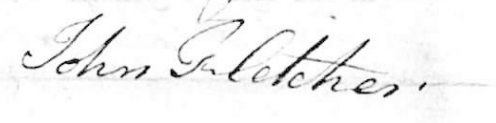
Cobbett implied that Fletcher could not write, but it may be that Fletcher simply lacked a venue for his writing. When he was discharged from the army he signed his discharge form. This document confirms that Fletcher was born in Bloxwich Parish, Walsall, Staffordshire in 1748, and that he was five feet five and a half inches tall, with a dark complexion, brown hair and grey eyes. He pursued the trade of buckle making before joining the 54th Regiment in 1770 at the age of twenty-two. The regiment's muster rolls show that he was with the 54th Regiment when that corps sailed to America in early 1776, first to the Carolina coast and then to Staten Island. The regiment participated in the Battle of Long Island in August 1776, and the campaign that took the City of New York. From there they went to Rhode Island where Fletcher spent three years before departing in the summer of 1779. The 54th spent the rest of the war in the environs of New York, taking part in raids on the Connecticut coast in 1779. When a peace treaty was signed in 1783, the 54th was one of several British regiments that voyaged from New York to Nova Scotia, remaining in Canada for several years. It was there that Cobbett joined the regiment as a young recruit (having been enlisted by a recruiting party in England) and met Fletcher.

John "Jack" Fletcher was discharged from the 54th Regiment in June 1792, six months after Cobbett, becasue he was “consumptive and rheumatic, and worn out in the service." He obtained a pension but, like many British soldiers, soon enlisted again. He served in the 86th Regiment from 1794 until July 1799, this time attaining the rank of corporal. He was discharged again in July 1799. Thanks to the strong impression he made on William Cobbett, we know something of what kind of man he was.

Information from this article comes from the following sources:

William Cobbett: Selected Writings, ed. Leonora Nattrass (London: Routledge, 2016) 

Discharges of John Fletcher, WO 121/14/455 and WO 121/148/410, National Archives of Great Britain

Muster rolls, 54th Regiment of Foot, WO 12/6398 and /6399, National Archives of Great Britain


Tuesday, March 8, 2022

Duncan Robinson, 49th Regiment, a very proper soldier for promotion

When Serjeant Duncan Robinson signed his discharge from the 49th Regiment of Foot on 31 July 1786, at the age of sixty, his signature looked like that of someone who had barely learned how to write. He had spent thirty-two years and two months in the army, ten as a private soldier in the 42nd Regiment during the French and Indian War, and the rest (possibly after a gap in his service) in the 49th. But the Perthshire native had been appointed corporal only five years before, and serjeant only one year prior to being discharged. He was recommended for a pension because he was "worn out in the service, having served seven years of the above time in the West Indies, and America last war, which has rendered him incapable of further service." Having learned the trade of carpentry before becoming a soldier, he had spent part of career "in the Engineers Department when employ'd in making the Kings works under the command of Colonel J. Montresor," an army engineer who oversaw a number of major projects in America, but in this work he "received several bruises," contributing to his incapacity. An army surgeon added that Robinson was "subject to rheumatism and also received severe hurts in the service, which from old age and infirmities, has prevented him from doing his duty during the winter months."

None of this was unusual for a discharged soldier, but the officer commanding the 49th Regiment wrote a letter to accompany the discharge describing some distinctive attributes of Robinson's character. He had, the officer wrote, "served honestly and faithfully," and "never was Confined during the whole course of his Service in the 49th Regiment." Clarifying the reason why he had remained a private soldier for so long, the officer wrote that Robinson "was always looked upon as a very proper soldier for promotion, but on account of his not learning to write, prevented him from being made a Non Commission’d Officer for which promotion he was justly entitled to." Moreover, Robinson had "frequently refused being appointed a Non Commissioned Officer himself, saying and giving for reason he would be Oblidged to no other soldier for writing his reports for him." Besides affirming the importance of writing for non-commissioned officers, this shows how prideful Robinson was in turning down positions that offered higher base pay and significant opportunities to earn extra money; he would have no man do his work for him, a testament to his integrity as well as his honesty (no one could falsify information in his name).

His commanding officer told more about Robinson: "He brought into the service, and into the 49th Regiment three sons, and three Nephews," showing how influential an individual could be in obtaining recruits for a regiment. In 1768 the author of a popular military text had recommended,

Men being most desirous of enlisting into a corps, where they are certain of meeting many countrymen, and perhaps relations; besides, it is a spur towards raising their ambition, to see some of their friends, who probably enlisted only a few years before, return among them in the character of Non-commission-officers, or sometimes in a higher station.

Muster rolls for the 49th Regiment confirm that several Robinsons were in the 49th Regiment between June 1775 when the corps arrived in Boston, and August 1778, the last available muster roll - Arthur, Daniel, John, Thomas and William. Military documents don't indicate who was related to who, but presumably all of these men were either sons or nephews of Duncan Robinson. Moreover, according to the 49th's commander, two "were killed in America, Non Commissioned Officers and the other lost his Arm at White Plains." Daniel Robinson was indeed killed while serving in the 2nd Battalion of Light Infantry near Philadelphia on 21 September 1777. Serjeant William Robinson was apparently wounded because he was reduced to private in late 1776, then discharged in April 1778; it may well have been he who lost his arm at the Battle of White Plains in October 1776. Rolls are incomplete during the time the 49th served in the West Indies beginning in late 1778; other Robinsons may have died while fighting the French in that harsh climate.

Duncan Robinson's thirty-two years of exemplary service and great contributions to his regiment earned him a pension. This was a portion of his pay as a serjeant, significantly more than that of a private soldier - which may have been the reason he was promoted just a year before he was discharged, so that his exceptional service would be well rewarded.

[Information for this post comes from the discharge of Duncan Robinson, WO 97/581/47, British National Archives; muster rolls of the 49th Regiment of Foot, WO 12/6032, British National Archives; and Bennett Cuthbertson, A System for the Compleat Interior Management and Economy of a Battalion of Infantry (Dublin, 1768)]

Learn more about British soldiers in America!

Sunday, February 20, 2022

Dennis Green, 5th Regiment, takes home a souvenir

Dennis Green was just thirteen years old when he joined the 5th Regiment of Foot in 1765. Born in the town of Mallow in County Cork, Ireland, he was probably the son of a soldier in the regiment and probably started his service as a drummer. By 1774, though, when the regiment arrived in Boston, he was 5 feet 11 1/4 tall, just right for the regiment's grenadier company.

Late in the evening of April 18, 1775, the grenadiers and light infantry from regiments in Boston were quietly assembled, ferried across the Charles River, and in the first hours of April 19 set off for Concord, a town twenty miles inland. By the end of that day the British army in America was at war with rebelling American colonists, and Dennis Green was among the war's first casualties and first prisoners. He was hit by a musket ball somewhere along the arduous retreat from Concord back to Boston, and left behind with a number of other wounded soldiers. Doctors were unable to remove the ball, and it remained in his body.

Some time between April and June 1777 he found his way back to his regiment. Whether he escaped or was exchanged has not been determined, but he was fit enough to go back into the grenadier company. He went with them to Philadelphia in 1777, and back to New York in 1778, then - as far as can be determined from the incomplete surviving muster rolls - continued with the regiment to the West Indies. By 1783, with hostilities ended, Green one among the many soldiers discharged as the size of the army decreased.

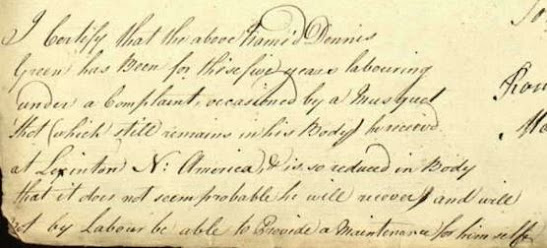
Dennis Green's discharge from the 5th Regiment, a printed form with personal details filled in that confirmed his obligation to the army was over, reveals the details about him related above - his age, place of birth, how long he had been in the army, and his height. It also includes a statement from an army surgeon:

I certify that the above nam’d Dennis Green has been for these five years labouring under a Complaint, occasioned by a Musquet shot (which still remains in his Body) he received at Lexinton N. America, & is so reduced in Body that it does not seem probable he will recover) And will not by Labour be able to Provide a Maintenance for himself.

He was out of the army, but carried with him a token of his first day at war. He was granted a pension.

Either the musket ball in his body was eventually removed, or somehow it did not cause him undue pain, for seven years later, in 1790, he enlisted in the army once again. He joined the 11th Regiment of Foot, was appointed corporal, and served for twenty months before being discharged and put on the pension rolls once again. This time no mention was made of a ball in his body; his discharge indicates that he suffered from "a Colliquative Diarrhea." He signed his name on his discharge, and there is no record of him serving again in the army.

Learn more about grenadiers and light infantry in America!

Wednesday, December 8, 2021

Elizabeth Willson, 26th Regiment, sells Fruit in New York

 In December 1775 the war in America was not yet a year old, but most of the 7th and 26th Regiments of Foot were already prisoners of war. They had been captured when undermanned garrisons on Lake Champlain and the Richelieu River were overrun by an American expedition bent on seizing the city of Quebec. Now housed in barracks in Lancaster, Pennsylvania, these two British regiments awaited an unknown fate, for no one knew how long the war would last or what the outcome would be.

When the garrisons of British posts fell, soldiers and their families became prisoners of war together. Among those at Lancaster was Befordshire native William Willson, a private soldier in the 26th Regiment, his wife Elizabeth, and their four children. William, a tailor by trade, had joined the army in about 1763 and probably continued to practice his trade while a soldier. When he married Elizabeth, and where she was from, are not known.

In the first half of 1777 the prisoners were finally exchanged. The soldiers and their families marched to the British-held city of New York. The soldiers soon took the field once again while Elizabeth Willson, like most army wives, worked to help support her family. She sold fruit in the city, demonstrating the resourcefulness of these women whose lives were inherently itinerant due to their husbands’ profession. She may have met acquaintances from New Jersey where the 26th had been posted in 1768, 1769 and 1770, who had fled to the city after war broke out.

The 26th remained in the New York area for a few years. But in 1779 the regiment received orders to return to Great Britain. What happened to William is not clear – he does not appear on the regiment’s rolls prepared in England in 1780, but decades later William deposed that he was discharged from the regiment in 1783. He may have remained in New York on some sort of special duty. He was certainly in England in June 1783, where he went before the pension examining board at Chelsea and was granted an out-pension for his twenty years of service.

It is also certain that Elizabeth Willson did not accompany him to Britain. In October 1783 she was still in New York, selling fruit from a stand “at the Head of Coenties Slip,” a byway that ran from Water Street to the East River. But she had become “much addicted to liquor” and was “frequently intoxicated.” A local resident who knew her “knew of no place of abode,” but had “frequently seen her lying drunk behind stoops.” In the late morning of October 21, she was found dead on the ground floor of an abandoned house, 52 Grand Dock Street “near the Royal Exchange in the South Ward.” The coroner found “no external marks of violence on her body to cause her death,” and ascribed her death to “liquor or sickness.”

Information for this article comes from the following sources:

Return Of The Prisoners Of The 26th Regiment, Taken At St. Johns And In The River St. Lawrence, And Arrived At Lancaster, Pennsylvania State Archives

Muster rolls, 26th Regiment of Foot, The National Archives of Great Britain

Out Pension Admission Books, The National Archives of Great Britain

Coroner’s report on Elizabeth Willson, British Headquarters Papers, The National Archives of Great Britain

Learn more about British soldiers in the American Revolution!

Sunday, August 22, 2021

Mrs. Fowles, 7th Regiment of Foot, draws provisions

 Mrs. Fowles and her daughter Ann drew rations in August of 1782 along with other soldiers and wives of the 7th Regiment of Foot. This is no surprise. Wives and children of British soldiers in America were fed by the army; most British regiments included - among those who they provisioned - wives of about one in six soldiers. Documents that include the names of these women are rare; the August 1782 provisions list for the 7th Regiment is the only one for that regiment known to survive that names each man and woman. Even so, it does not give the names of the wives, listing them only as "Mrs. Fowles," "Mrs. Bright," "Mrs. Carney," etc. We've deduced that "Ann Fowles," also on the list, is Mrs. Fowles daughter, as a number of children are listed with their first and last names.

What makes Mrs. Fowles important, in terms of our understanding of how wives were treated by the army, is that her husband, Sergeant William Fowles, died on 25 April 1781. The only man on the regiment's muster rolls with that surname, he was already in the 7th Regiment when it arrived in America in 1772, landing at Quebec. A private soldier at that time, he was appointed corporal in February 1780, and sergeant exactly a year later. No details of his specific service have been found at this time; presumably he was among the men of the 7th Regiment captured in 1775 and repatriated two years later, and he was with the regiment at the siege of Charlestown, South Carolina, in 1780. Whether he died of illness in garrison or on campaign, or of wounds in one of the 7th's several battles in the Carolinas, he left his wife a widow only two months after being appointed sergeant.

It is also not known when William Fowles married. Mrs. Fowles may have accompanied the regiment from Great Britain in 1773, or met her husband in America. And her fate after August 1782 is also unknown; the provision return is the only record we have of her.

There is folklore that widows of British soldiers were required to remarry within days of their husband's death, or they would be struck off the provision rolls and turned out of the regiment no matter where it was. This has already been shown to be untrue from records of widows remarrying months or years after their husbands died. By drawing provisions seventeen months after her husband died, Mrs. Fowles provides one more example that soldiers' widows remained part of the regimental community until they could establish themselves in new circumstances.

Friday, July 16, 2021

Andrew and Susannah Carr, 21st Regiment - separated

 "Serjeant Andrew Carr," wrote his widow Susannah, "was taken prisoner along with the army commanded by General Burgoyne in the year 1777 and conveyed to a depot in the state of Virginia in the said United States, where the said Andrew Carr died." She wrote on behalf of their son John, born in 1775, the year before the 21st Regiment of Foot said from Great Britain to Quebec.

Andrew Carr was a native of Kilmore on the Island of Skye, born in 1740. He joined the army at the age of twenty, without having learned a trade beforehand, but he must have been reasonably well-educated for he soon became a sergeant.

The 21st Regiment was sent to Florida in 1765 and remained there until 1770. Many histories of the regiment indicate that the regiment then went to Quebec, overlooking the time that they spent in Pennsylvania, New Jersey and New York in 1771 and 1772. It was probably in Philadelphia in 1771 that Andrew Carr met and married Susannah Stauss, daughter of an area landowner, who was in her early twenties. When the 21st did go to Quebec, and then back to Great Britain in 1773, Susannah followed her husband in her new life as an army wife.

John Carr was born in 1775, and early the following year the family set sail once again, one of nine regiments bound for Quebec to drive rebellious American military forces out of the province. The campaign was successful, and the 21st Regiment spent the winter of 1776-1777 at St. John's on the Richelieu River between Montreal and Lake Champlain. When the army marched south in June 1777, only two wives were allowed to go with each company on campaign. Susannah and young John stayed behind while Andrew Carr went on the expedition commanded by General John Burgoyne. Their destination was Albany, but the got only as far as Saratoga. Susannah never saw her husband again; he was, as she knew, taken prisoner. The captured soldiers went first to the Boston area, expecting to be sent back to Great Britain, but then were marched to Virginia, then to Pennsylvania, ultimately spending five years in captivity.

In 1782, Susannah's father, still in the Philadelphia area, died. the executor of his estate placed an advertisement in the newspaper seeking information on the whereabouts of Susannah and her three siblings:

WHEREAS BELTHASER STAUS, late of the Northern Liberties of the city of Philadelphia, yeoman, deceased, by his last Will and Testament, ordered his estate to be sold, and the money arising from the sale thereof to be equally divided between his eight children, whereof four are living in and near the city of Philadelphia, and four absent, namely two sons FRANCIS JOSEPH and DANIEL, and two daughters SARAH and SUSANNA. The shares of which said four absent children he ordered to be put out, and continued at interest for the space of seven years, to be claimed by the said children or their legal representatives in person, &c. And of his said last Will and Testament he appointed Zacharias Endres, of the said Northern Liberties, brewer, sole Executor.

Now the said Executor, in compliance with the special directions of the said Testator, given him a few days before his deceased, has thought proper to give this PUBLIC NOTICE, hereby requiring the said four absent children of the Testator, or in case of the death of any of them, the children or guardians of the children of the deceased, to make their claims to their respective shares. The said Executor is informed that the said Francis Joseph Staus is by trade a skinner, and was some time Paymaster of the British troops in East Florida; that the said Daniel Staus was a Captain of a vessel, and an inhabitant of the Island of Providence; that the said Sarah had been married to one Andrew Lytel, and is now a widow, living somewhere in North Carolina; and that the said Susanna was married to one Andrew Kehr, of the 21st regiment of Scotch Fuziliers, who, it is said, is among the prisoners of General Burgoyne’s army, now in Virginia.

All friends and acquaintances of the persons concerned, seeing this advertisement, are desired to inform them thereof. The said Executor will take particular care that the money happening to each child’s share may be recovered upon short notice.

Philad. Sept. 5. ZACHARIAS ENDRES.

[Pennsylvania Gazette, 18 September 1782]

She was not in Virginia with her husband, as the ad suggested, but was still in Canada; and by this time, she had learned that her husband died. Whether she ever got her inheritance is not known. She remarried a discharged German soldier named Conrad Bongard. They settled on 500 acres of land that he was awarded in Ontario and had several children together. It was in 1836 that she wrote her brief petition concerning her first child, John Carr, apparently seeking pension benefits or land based on her deceased first husband's service. She died on February 21, 1846 at the age of 98.

What she never learned was that Andrew Carr did not die in Virginia. He survived the years of captivity and returned to England in 1783 with the remains of the 21st Regiment. On May 21 of that year he went before the pension examining board in Chelsea and was awarded an army pension for his 23 years of service. How long he lived thereafter is not known.

Andrew and Susannah Carr were not the only couple separated by war, neither knowing the other's fate. We'll never know how may others there were.

Learn more about British soldiers in America!


Tuesday, December 8, 2020

Noble Volunteers: the British Soldiers Who Fought the American Revolution

 It's finally here.

It took two years to compile and organize information collected over several decades, followed by two years of writing, revising and editing. Now the most authoritative book on British soldiers in the American Revolution is available in stores and from online retailers.

Noble Volunteers: the British Soldiers Who Fought the American Revolution tells about how soldiers were recruited and trained in times of peace and war, how they prepared for hostilities and adapted to warfare, where they lived, what they ate, what they earned, the illness, hardships and punishments that they suffered, how their careers evolved, and what became of them when the war was over. Rather than characterize the army as a mass of homogeneous men, this book emphasizes the individuals and their broad range of experiences. Read the review in the Wall Street Journal!

The book is available from major retailers, but please obtain it from your local independent bookseller, or from a historic site book shop - these organizations need your support.

For a good price, we recommend the Fort Plain Museum.

Signed, personalized copies can be ordered from Books on the Square in Providence, Rhode Island.


Sunday, September 13, 2020

Mary Kiddy, 43rd Regiment, knows what is owed to her

Mary Kiddy was on her own in New York in January of 1783. Some money was owed to her, and it is because of this that we know of her existence. But the brief summary that was recorded leaves mostly questions about her life and experiences.

Mary Kiddy was married to William Kiddy, a soldier initially in the 34th Regiment of Foot and later in the 43rd Regiment of Foot. Thanks to muster rolls for these regiments, we do know a lot about him. He joined the 34th Regiment some time between 1761 and 1768 (a gap in the regiment's rolls prevent knowing when or where). In 1768 he was a private soldier in the 34th Regiment in Philadelphia. The following year, the 34th returned to Great Britain, spending the next several years at various posts in Ireland. By April of 1776 he was a corporal in the regiment's light infantry company, preparing to return once again to North America, this time part of the force bound for Quebec to dislodge American force besieging the city.

After a highly successful 1776 campaign and a winter in Canada, in the summer of 1777 the the 34th's light infantry was part of the expedition under General John Burgoyne that set out from Canada towards Albany. By the time this campaign ended in October, Kiddy was a prisoner of war, and spent the winter of 1777-1778 in a crude barracks outside Boston. From there the prisoners were moved inland to Rutland, Massachusetts. It was here that he fell ill, so much so that he was sent to New York in a cartel rather than going with other prisoners to Virginia.

In the summer of 1780 he was sufficiently recovered to return to active service. With most of the 34th Regiment still in Canada and his own company still prisoners of war, Kiddy was drafted into the 43rd Regiment of Foot. Muster rolls for the 34th Regiment's light infantry company end in early 1777, and the rolls for the 43rd record Kiddy as having "enlisted"in June 1780, with no indication that he had been in the 34th Regiment; if it were not for his wife, nothing about his time as a prisoner of war, or that the man in the 34th was the same man who joined the 43rd, would be known.

In April 1781 the 43rd Regiment sailed to Virginia, part of a reinforcement of British forces operating in the Tidewater area. Also that month William Kiddy was appointed corporal again, returning to the rank he had held for years in his previous regiment. During the summer they joined up with General Charles, Lord Cornwallis's army in Yorktown. It was there that William Kiddy died. The 43rd's muster rolls record his death as occurring on 24 October, but the 24th of the month is often used on muster rolls when an exact date is not known, so we cannot be sure exactly when he died. The cause of death is also unknown; he may have fallen ill in the deprived conditions when Cornwallis's army was besieged, been wounded during the intense artillery bombardment they endured, or fallen to some other cause.

Mary Kiddy was left a widow, which meant that she was entitled to her late husband's estate. In January 1783 a board of officers in the city of New York was hearing claims from soldiers who had been prisoners of war, escaped or been exchanged, and then joined different regiments, leaving their accounts with their previous regiments unsettled. Mary Kiddy went before the board and petitioned for her late husband's back pay and clothing due from the 34th Regiment, and she knew exactly what was owed: "three suits of Cloathing for 1776, 1777 & 1778 & a balance of 1.9.4 ½ due from the 34th Regt on the 17th Novr 1778, she also claims her husbands intermediate pay from the 17 of Novr 1778 to the 24th of June 1780, amounting at 8 per day to L19.10". Soldiers received a new suit of regimental clothing each year, and William Kiddy had not received his for the last three years that he was in the 34th; on the last day that his company's accounts were settled in 1778, he was owned one pound, nine shillings, four and a half pence; and he was also owed pay from the day of that last settlement and until the day he joined the 43rd Regiment. She computed the pay at the rate owed to a private soldier, which may be a simple error on her part, or may mean that her husband was reduced to private soldier after the last available muster roll in February 1777 and before accounts were settled in November 1778.

The brief record of Mary Kiddy's statement to the board explains that her husband was in the 34th, was left sick at Rutland, was exchanged and went to New York, that he joined the 43rd Regiment and died in Virginia. It says nothing of her experiences. When did they marry? Was she with him in Canada? Was she on the 1777 campaign, and among the prisoners in Rutland? Or did they meet and marry in New York? Did she accompany him to Virginia? Her statement reveals much about her husband, but little about her - including what became of her after January 1783.

Learn about British soldiers, from the most comprehensive work ever published!

Wednesday, February 5, 2020

Massacre Men: Soldiers of the 29th Regiment charged for the events of 5 March 1770

Eight soldiers of the 29th Regiment of Foot were directly involved in the Boston Massacre on 5 March 1770. Their names are well known, because they all stood trial: Corporal William Wemms (or Wemys), and privates John Carroll, James Hartigan, Matthew Kilroy, William McCauley, Hugh Montgomery, William Warren and Hugh White. Considering how much notoriety they got from the massacre and trial, surprisingly little is known about them as individuals. For five of these men, we have nothing more than their service records as indicated in surviving muster rolls, and even that information is incomplete.

All of them were in the regiment when it arrived in Boston in 1769; no muster rolls survive from before that time to indicate when any of them joined the army. Cpl. Wemms, in a battalion company at the time of the massacre, was appointed sergeant in May 1771, but just six weeks later he was reduced to private again. This may have been due to illness or disciplinary issues, but whichever it was, he recovered sufficiently to be appointed sergeant once again some time in 1772. He was still in that capacity at the end of July 1775 while the regiment was in England, but was no longer in the regiment when the next set of rolls was prepared in Canada; his fate is unknown.

John Carroll was in the grenadier company, was appointed corporal in December 1770, and sergeant some time between July 1775 and February 1777. His company went on the ill-fated expedition under Gen. John Burgoyne that ended at Saratoga in October 1777. Because the company was among those captured, there are no muster rolls after February 1777, and no further record of John Carroll.

James Hartigan, another grenadier, married Elizabeth Henderson in Boston in September 1769. When the regiment was in Perth Amboy, New Jersey, he died on 4 November 1771.

William McCauley, a grenadier whose wife Mary had come with him to America, was appointed corporal some time before May 1771 and was still in that capacity when the regiment was in Canada in February 1777; like Carroll, McCauley's fate is unknown.

William Warren also was a grenadier in 1770, but later went into a battalion company. He continued with the regiment during the American Revolution, serving in Canada as late as October 1783, but once again a gap in the muster rolls leaves his fate unknown after that.

Matthew Kilroy and Edward Montgomery were the only two men convicted for the events of 5 March 1770. Both men continued to serve in the regiment, right up to the time that it was ordered to America in 1776. Perhaps in light of their conviction, both men were discharged rather than send them back across the Atlantic. They both went before the army pension board in Chelsea, outside London, on 22 February 1776, where the examiners duly recorded some details about them. Kilroy, a native of Mountmellick in County Laois, Ireland, was twenty-eight years old and had served thirteen years in the army; he was granted a pension because of a lame knee. His trade is listed as "labourer," meaning that he had not learned a trade before enlisting. Montgomery, from Antrim in Ireland, was forty-one years old (meaning that he was about thirty-five in March 1770), had served twenty years in the army, and was also a labourer. He and his wife Isabella were frequently mentioned by deponents recounting violence between British soldiers and Boston inhabitants in the months leading up to the Boston Massacre, she being recalled as saying that "the town was too haughty and too proud."

The man who remained in the regiment longest, and about whom we know the most, was Hugh White. Town records indicate that he had a wife and three children in Boston in 1770. A copy of his discharge, the document that says he had legally completed his service in the army, was lodged with the pension office when he received a pension, and remains in the British National Archives to this day. From this, we learn that he was born in the town of Killyleach, County Down in Ireland, in 1740 (more specifically, he was forty-nine years old when he was discharged on 10 November 1789). Like Kilroy and Montgomery, he was a labourer. He joined the army in 1759, a likely age for an enlistee, and served his entire career in the 29th Regiment. The regiment's muster rolls show that he served in Canada during the American Revolution. And he was able to sign his own name on his discharge, suggesting that he was a literate man.
Of eight soldiers who were caught up in such an important moment in history, we have only these sparse details about them as people, shedding real light on only three of them. Research continues; perhaps some day we'll know more.

Friday, November 22, 2019

John Ward, 74th Regiment, wins back his Pocketbook

When John Ward boarded the warship HMS Iris in Halifax, Nova Scotia on 16 February 1779, he probably thought he had fought his last fight. He was going home to Great Britain, having spent seventeen years as a soldier and suffered a wound somewhere along the way. At the age of fifty-four, his soldiering days were over, but he was heading towards one last conflict.

Ward was Irish, a Belfast native born in 1725. Most of his military career has not been determined. He probably enlisted during the Seven Years War, maybe before, and then was discharged. Part way through the American Revolution he answered the call for volunteers to join the 74th Regiment of Foot, a new regiment authorized in December 1777 and raised largely in Argyllshire. Like many new-raised regiments, its ranks were filled by a mix of new recruits and experienced veterans; men like Ward, with prior military experience, insured that the corps would quickly be ready for the demands of foreign service in spite of being newly created.

The regiment recruited throughout the first half of 1778, and sailed for Nova Scotia in August of that year. Once in Halifax, Ward’s age and injuries apparently caught up with him; he may have been wounded somehow during his brief time in the 74th Regiment, or had a lingering disability from a wound received in the past. Before the regiment went to a war zone, he and a few others from the 74th were “invalided” - discharged because they were not deemed fit for service. In February he and the other invalids, still in Halifax, embarked for the journey home.

Ward and his comrades disembarked from Iris in Portsmouth on 20 March, and by 25 March were in London. They took rooms for the night at a tavern in Westminster where “we laid down our knapsacks, and drank pretty heartily.”

Lodging in the same place was John Close, a soldier in the 3rd Regiment of Foot Guards. He ate and drank with the veterans, and said he was an Irishman like Ward. The next morning, Ward and his comrades went to the War Office and received billets for quarters in Chelsea, where they would go before the pension board. Returning to the tavern, they met up with Close again, who accompanied them to Chelsea that afternoon.

After finding the billets at Chelsea, Ward and Close went to a local tavern, ate, and drank some beer. Ward drew out his leather pocketbook which contained about two months’ pay that he’d received when he was discharged, and paid the bill. He then left Close and returned to the previous night’s tavern where he wanted to spend some of his money, as the owner had given him a free meal the night before. Close arrived later on. Some time and two pots of beer later, Close agreed to walk Ward, now somewhat tipsy, back to Chelsea.

Along the way, Close pulled Ward off the road. In the darkness, he grabbed Ward’s lame arm, which had no strength due to its wound, leaving Ward unable to effectively resist. Close reached into Ward’s breast pocket and took the pocketbook full of cash that he had seen earlier that day. Ward, with the coolness of a veteran soldier, asked for the pocketbook back, but chose not to pursue or cry out when Close went off into the night. He knew where Close lived, knew he could identify him, realized that he might leave town if he feared pursuit, and recognized that his own lameness and inebriated state rendered him unable to best Close in a confrontation. Ward knew his best chance at recovering the pocketbook was to remain calm.

John Close returned to his quarters early the next morning, and went to his room to prepare for his duties as a soldier that day. Soon after, John Ward and several of his comrades arrived and told the tavern owner what Close had done. The owner summoned Close, who denied the charge, but while Close talked with his accusers the owner went to his room and found the pocket book hidden in a closet.

John Close was brought to trial at the Old Bailey in London the following week, on April 4, 1779. John Ward told his story and described exactly how much money was in the pocketbook. The keeper of the tavern where Close lodged testified, as did the keepers of two other taverns where Close had spent money freely on the night of the theft. The pocketbook was shown to the court.
Close offered only a brief defense, claiming that Ward had given him money but offering no explanation of how he came to possess the pocketbook. He called on his sergeant as a character witness, but the sergeant said only that Close had been in the regiment for a year, and that he knew nothing else of him. This was no defense at all, and the court found Close guilty of theft. He was sentence to “navigation,” a year of hard labor dredging the Thames River to improve its navigability.
The court records don’t state whether John Ward recovered all of his money, but he did go before the pension board on 17 June and received a pension.

The trial transcript contains two errors, which show the challenges of relying even on primary sources when piecing together historical events. Ward sailed from Halifax to Portsmouth on HMS Iris, as confirmed by that ship’s muster books, but the court recorder wrote that he came from America on the ship Halifax - an easy mistake to make. The transcript also says that Ward called himself “a soldier in General Burgoyne’s regiment.” This statement is difficult to interpret, since General Burgoyne was colonel of the 16th Light Dragoons and had no connection with the 74th Regiment. The tavern keeper said that “John Ward, with several others belonging to the 74th regiment of foot” lodged at his place, and the Iris muster books and the pension board examination records list Ward as belonging to the 74th Regiment. The 74th Regiment’s muster rolls are incomplete for this time period, but there is no apparent connection between General Burgoyne and the 74th Regiment, or any indication that men were transferred from Burgoyne’s regiment to the 74th. For now, the discrepancy is a curious quirk in the historical record.

Wednesday, July 24, 2019

Thomas Swift, 37th Regiment, and his wife come to America

The village of Thurcaston in Leicestershire has a primary school that was founded in 1715. It is quite possible that Thomas Swift, born in the village in 1749, attended this school before pursuing the trade of framework knitting, making stockings in the rapidly-mechanizing British textile industry. He left the trade behind at the age of twenty to become a soldier.

He joined the 37th Regiment of Foot, probably just after its return from six years in Menorca. This afforded him several years to learn his military trade while the regiment was posted in England, Scotland and Ireland. By 1775 he was in the regiment's light infantry company, and by the time the regiment embarked for America in early 1776, he had gotten married. The couple sailed from Ireland with a fleet that aimed to open a southern theater in the American war in 1776.

By June, the 37th Regiment was encamped on Long Island, not the well-known place in New York but a sandy barrier island just north of Charleston, South Carolina. In spite of the hot weather, the army had remained healthy in the sea breezes. Late in the month the soldiers watched helplessly as British frigates futilely bombarded Fort Moultrie, the army's plans to attack foiled by the depth of the channel between Long Island and the fort's island, which they had intended to wade across. The army remained on Long Island into July, then sailed north to join the troops already on Staten Island preparing for the campaign that would capture New York City.

The light infantry companies of seven regiments that came from South Carolina to Staten Island were formed into the 3rd Battalion of Light Infantry for the campaigns that ran from August 1776 through June 1777.

For the campaign to Philadelphia in the second half of 1777 the light infantry was reorganized into two battalions, with the 37th's company in the 2nd. Thomas Swift was certainly involved in these campaigns, but nothing remarkable is known of his individual service until September 20, 1777, the date of the battle of Paoli. Swift was among the soldiers of the 2nd Battalion of Light Infantry that marched for hours through the night to surprise an American brigade in their encampment, descending with bayonets upon the sleeping American troops in the darkness.

As the mayhem subsided, a man wrapped in a blanket emerged from tall grass near a fence and surrendered himself to Thomas Swift and a fellow soldier of the 37th. The man wore a Continental Army uniform, blue with red facings. He offered his musket, pointing out that it had not been fired. And he explained that he had deserted from the 23rd Regiment of Foot in Boston back in 1774. He was now serving in the 11th Pennsylvania Regiment, and said he had tried several times to desert and return to British service. As he was pleading his case, a sergeant from another British regiment came by and wounded him with a bayonet.

McKie, who had in fact deserted from the 23rd Regiment on 9 December 1774, was tried by a general court martial a week later in Germantown, just outside of Philadelphia, where the light infantry battalions were encamped. Two sergeants of the 23rd Regiment testified at the trial, and Swift and his colleague related their capture of the man now charged with "having had correspondence with and bourne Arms in the Rebel Army." McKie was found guilty and sentenced to death.

Five days after the trial, Thomas Swift was fighting for his own life. At dawn on 4 October an onslaught of Continental soldiers routed the light infantry from their camp. During the course of a fierce battle British forces turned the tide and won the day. Somewhere in the fray Swift was wounded in the left arm. The injury was not severe enough to end his service, though; he continued on in the 37th Regiment’s light infantry.

The muster rolls prepared in Philadelphia in February 1778 record Swift as a prisoner of war; by the time of the next rolls, August 1778, he was back with his company in the New York area. No details have yet surfaced about his captivity or exchange.

In early 1781 the light infantry, now operating as a single battalion given the reduced numbers of regiments in New York, was sent on an expedition to Virginia. In the summer they joined with the army under General Cornwallis that had come to Virginia through the Carolinas, and settled in to the post at Yorktown. By October they were under siege from American and French forces.

On the night of October 15-16, British light infantry conducted a sortie into the American trenches and put several cannon out of action. It may have been during this action that Thomas Swift was wounded “in the belly,” or he may have been wounded the following day, the last day that shots were fired. A cease-fire was called on the 17th, and the British troops surrendered on the 19th.

Probably because of his wound, Swift was not among those who spent the next eighteen months imprisoned. He returned to New York, and to duty with the 37th Regiment. On June 15, 1783, after peace was negotiated and the fellow soldiers of his company were released, Swift was appointed corporal. He and his regiment returned to Great Britain later that year.

The man who had been twice wounded and spent time as a prisoner of war stayed in the army. H was reduced to a private soldier in November 1785, but at some point after that was appointed corporal again. He served until the end of 1790, taking his discharge in Canterbury on December 23. Besides his wounds, his discharge recorded that he was “rheumatic and worn out in the service.” He received two extra weeks of pay, and made his way to Chelsea where he went before the pension board and was granted a pension early in 1791. In 1798, he spent a few months in an invalid company.

Of his wife, far less is known. She was certainly with him on Staten Island in 1776. And in the New York area in late 1778, she earned four shillings eight pence for making a shirt and a pair of leggings for the 37th Regiment’s light infantry company. Her first name is not recorded.


Wednesday, May 22, 2019

Jacob Margas, 54th Regiment, leaves spectacles for soldiering

People ask why men chose to join the army, and my usual answer is that we don’t know, except for the few men who wrote down their reasons. For example, why did twenty-four-year-old Jacob Margas join the army instead of carrying on his family business? 

Born in 1743 in the London suburb of St. Martin’s, Margas apprenticed as an optician under his father, John Margas, at their shop “at the sign of the Golden Spectacles,” operating at different locations near Long Acre in London. Jacob’s grandfather, also Jacob Margas, had been a goldsmith of some note in London. John Margas and son Jacob worked through a bankruptcy in 1758 and moved to Dublin the following year, where they went into business on Chapel Street. John Margas died in 1767 and Jacob, rather than continue as an optician, enlisted as a soldier in the 54th Regiment of Foot. Was he distraught at the loss of his father and mentor? Did he fear the prospect of another bankruptcy? Did he feel liberated from a line of work that he never liked in the first place? Without a record of his reasons, we can only guess. 

Margas exhibited such skill as a soldier that he was appointed corporal after only two years, and sergeant four years after that, a quick rise in a profession where most men spent their entire careers as private soldiers. Standing five-foot-six-inches tall, with brown hair, grey eyes, a round visage and fresh complexion, his business background surely gave him the skills needed to easily master the paperwork that was part of a sergeant’s routine. 

The 54th Regiment came to America in early 1776, part of the expedition that was intended to open a southern theater of war. The failure of that endeavor brought the 54th to join General Howe’s army on Staten Island in the summer. After that army secured New York City, the 54th was part of the expedition that seized Rhode Island in December. Once the island was secure, one British and one Hessian brigade was left there as a garrison. 

The 54th remained in Rhode Island until the summer of 1779. After General Robert Pigot took command of the garrison in the summer of 1777, Sergeant Margas was appointed provost martial because of “his Attention and Alertness,” a post of significant responsibility that also earned additional pay. Margas remained in this post until the 54th left the island; he had the option to remain, but opted to go with his regiment. 

Somewhere during his service in America, the optician lost sight in one eye. This may have been during the battle of Rhode Island in August 1778, or the storming of Fort Griswold in September 1781, and action in which the 54th Regiment was hotly engaged. But no record survives of the circumstances of his loss. 

In spite of his impaired eyesight, Margas continued in his role until November of 1791, having served a total of twenty-three years. He received a pension, based on a memorial written by an officer of the 54th who called him “a vigilant, honest and meritorious Soldier and non-commissioned Officer.” His being “very much afflicted with rheumatic Complaints,” and blindness in one eye, made him an object of compassion for the pension board. Margas moved to Berkshire to live on the estate of a retired officer. 

Soon after, he was contacted by political publisher William Cobbett. Cobbett, who had been a soldier and non-commissioned officer in the 54th Regiment with Margas, was pressing charges against some of the regiment’s officers for various forms of misconduct, and wanted Margas to come to London to testify on his behalf. Margas and a several dozen other witness duly appeared at the trial in London in March 1792, but Cobbett himself was nowhere to be found. The charges were read and all witnesses given the opportunity to voice their opinions, but none of the charges were substantiated and the case was thrown out. 

Jacob Margas still had more to give to the army. He was brought off the pension rolls to serve with the 47th Regiment for a time, and discharged back onto the pension rolls in December of 1803. The man who had walked away from three generations of family business had done well for himself in his new profession as a soldier.


Tuesday, March 19, 2019

Cornelius Killegrew, 34th Regiment, a man of the sincerest integrity

Many men spent their entire military careers as private soldiers, but intelligent, literate men could advance quickly. The army needed capable non-commissioned officers, and was quick to recognize those who had the skills and capacity. Cornelius Killegrew was one such man.

Born in Edgeware just north of London, Killegrew learned to be a comb maker. Instead of pursuing this trade, however, he enlisted in the army when he was seventeen years old in 1765. What drew him to the army is not known, given that he had a trade that was probably in some demand in a metropolitan area, but he soon proved to be capable of leadership.

After just three and a half years, the 5-foot 9-inch tall soldier was appointed corporal, a significant step up in responsibility that also brought higher base pay and more opportunities for extra earnings. In 1775 he was appointed sergeant, the pinnacle of advancement for most enlistees.

His regiment, the 34th Regiment of Foot, sailed to Quebec in 1776 as part of the expanded British commitment to the American war. During the famous 1777 campaigns that attempted to split the colonies, Killegrew was among 100 men of the 34th with the detachment under his own regiment’s lieutenant colonel, Barrimore St. Leger, who held the local rank of brigadier general. They made their way to Lake Ontario, then along the Oswego River, and over land to Fort Stanwix.

Sergeant Killegrew was “appointed provost Martial at 2s-6d pr day for the Expedition and to be obeyed as such,” meaning that it was his job to receive and provide guards over all prisoners. This included enemy prisoners of war and soldiers on the expedition who had committed disciplinary infractions, including apprehended deserters. He probably had to pay expenses of his duty out of this stipend, which was in addition to his regular pay as a sergeant, but he nonetheless stood to profit from this posting. It was one of the myriad ways that British soldiers and non-commissioned officers earned more than their base pay, allowing them to live better than the subsistence-level base pay would allow. This extra earning potential that was pervasive in military duty may have been a factor in so many men choosing the army as a career.

And Killegrew had a long career. He spent thirteen years as a sergeant, and another six years as the 34th Regiment’s sergeant-major. He finally took his discharge in April of 1792 when the regiment was posted on the Isle of Guernsey.

Rather than return to his native London, Killegrew went to Ireland. In 1793, when the City of Limerick Militia was formed, he was appointed sergeant-major, bringing his twenty-seven years of experience in the regular army to the job.

The City of Limerick Militia had its moment of glory in the 1798 rebellion.  They were sent north to help repel a French invasion. On September 5, a force consisting primarily of some 200 infantry from the militia, supported by a few cavalry and others, was posted at the village of Colooney five miles from Sligo. Orders had come to abandon the village, but the militia instead took post at a critical defile. They held the position against an attack by five times their number, repelling French forces supported by Irish rebel militia in a four-hour engagement. So important was their stand that a silver medal was struck and awarded to each of the participants, bearing the inscription “to the Heroes of Colooney.”

At this writing, it is not known whether Sergeant-Major Killegrew was at the battle. He may have been in the thick of the fight, or he may have been back in Limerick handling administrative tasks. Either way, he soldiered on for another twenty years. He is one of very few soldiers to have an obituary posted, in the 16 September 1818 edition of the Limerick Chronicle:

Died - This morning, in Mary-street, aged 74, of gangrene in the leg, which baffled professional skill, Mr. Cornelius Killegrew, Serjeant-Major of the City of Limerick Militia since its first formation, and formerly of the 34th regiment; a man of the sincerest integrity. His remains will be interred with military honors to-morrow, at four o’clock afternoon.


Learn more about British soldiers in America!